
We usually think about systems as a way to make work more efficient: checklists, automations, templates, documented processes… and AI.
That’s accurate. But systems can do something else, too. They can make it easier to follow through on the kind of behavior you want to be known for. I learned that, in part, from a habit I adopted a decade ago.
My 10-year candy habit
In October 2016, I read an article from Peter Shankman called “My Secret Eight-Dollar Guaranteed Flight Upgrade Trick.”
The headline was intentionally provocative. Peter’s actual point wasn’t that a bag of candy would magically get you upgraded to First Class. He brought candy for the crew members because it was a nice thing to do—and because a happier crew would “upgrade” the flight experience for everyone on board.
I liked the idea and started doing it myself—and soon decided I would do it on every flight. Since then, I’ve brought candy on 400+ flights. In fact, I’ve missed doing this on just two flight segments in 10 years.
The routine is simple. Before a trip, I buy candy at the supermarket and put it in my luggage. Since Covid, I opt for individually-wrapped options like Hershey’s Miniatures.
When I board, I hand it to the lead flight attendant and say: “This is for you and your colleagues.” That’s it.
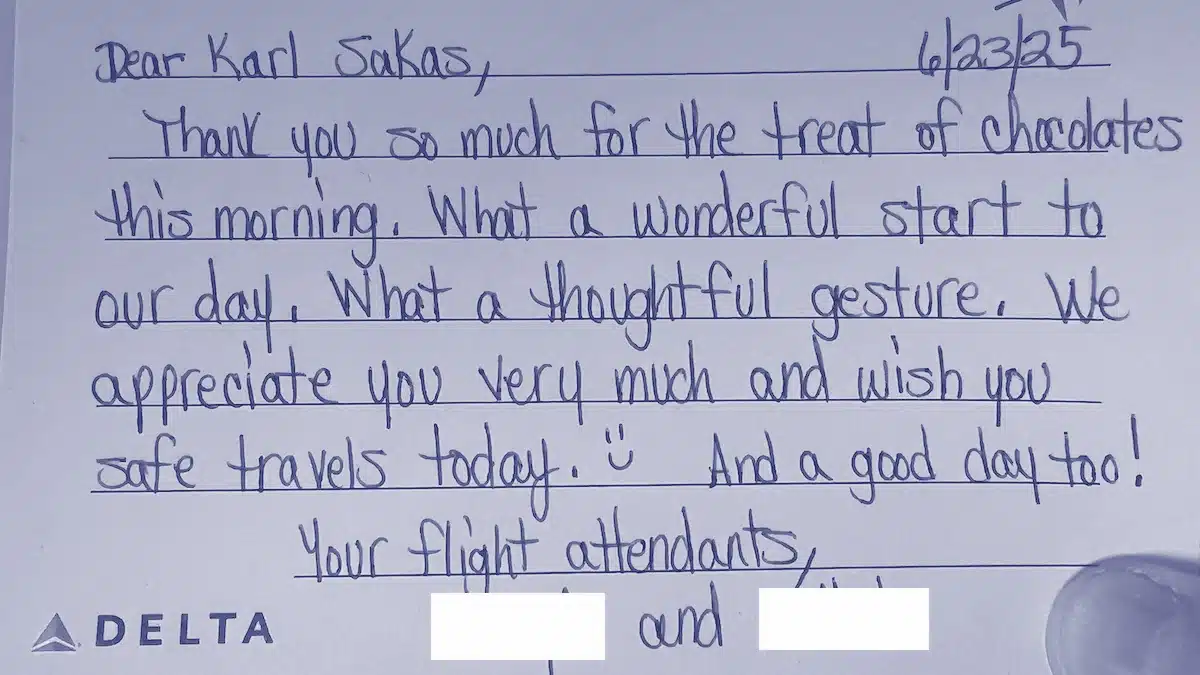
Occasionally, other crew members will stop by my seat to say thanks. On an American Airlines flight, I received a note on a watercolor-painted notecard. On a Japan Airlines flight, the crew gave me a JAL “Remove Before Flight” bag tag that I still use.
But I don’t do it to get anything back. I’m occasionally offered a free drink, and I usually decline. The candy isn’t (and hasn’t become) a secret “upgrade” strategy; as a frequent flyer, I know it’s worth it to book the seat I want.
One flight, though, made the candy habit especially memorable.
The flight where it mattered
Late one evening, I was flying home from Washington, D.C., to Raleigh-Durham amidst weather delays. Our plane was at the gate, but the crew wasn’t. The agent eventually explained that they were on a delayed inbound flight. We now wouldn’t leave until nearly midnight.
When the crew finally arrived, they hustled through the terminal to get us boarded. One passenger made a rude comment about how they weren’t moving fast enough. That struck me as unfair; it wasn’t as though the crew wanted to be late.
I boarded and handed over the candy as usual. It was a regional jet: two pilots, two flight attendants.
We finally reached Raleigh after 1:00am. As we deplaned, the lead flight attendant stopped me and said:
“Thank you. That was the only food we had to eat since breakfast.”
I’ve never forgotten that.
Most of the time, candy is just candy. But you don’t know what someone else’s day has been like, and you can’t predict when a small gesture will matter more than usual. That’s one reason I like to turn good intentions into simple systems.
Remove the friction before you need to act
Creating systems makes it easier to take action. For example:
- I don’t wait until I’m at the airport to decide whether to buy candy. I buy it ahead of time, store it in the pantry, and load it in my bag each time I pack for a trip.
- I do the same at home. I keep stationery, greeting cards, and stamps on hand so I don’t have to hunt for them. I bought an accordion file for the cards, and eventually added a rotating rack.
- I start planning my year-end gifts months in advance. Not because the late-October mailing takes months, but because starting early makes it much less likely that someone gets forgotten in December.
None of these systems makes the gesture more meaningful by itself. They simply reduce the odds that friction gets in the way.
The same principle applies in your work, too.
Your employee onboarding process sends a message
When someone joins your team, I recommend you send them the design proof for their new business cards before their start date. It’s a small thing, but it sends a message: “We’re expecting you. We know you took a risk in leaving your current job—and we’re committed to holding up our side of the bargain.”
The rest of employee onboarding should reinforce that. Their computer should be ready, their email should work, and their SaaS accounts should already exist.
I’m sensitive to this because I once started a job where I had to wait several days for a working email address. Nobody there intended to send a negative message. But the experience still communicated something: “We hired you, but we weren’t quite ready for you.” At the time, it made me wonder if I’d made the right career move.
That’s the difference between your good intention vs. what’s actually perceived by your team. First impressions matter.
Systematize the opportunity, not the emotion
Some leaders worry that putting recognition or thoughtfulness into a process makes it artificial—but that doesn’t have to be true.
A system can create the opportunity without scripting the emotion.
- A reminder might tell a manager that someone’s work anniversary is approaching. But the reminder has only created the opportunity for the manager to communicate genuine—and timely—recognition.
- An onboarding checklist reminds your team to prepare a new employee’s laptop and email account—but it won’t automatically make someone feel fully and genuinely welcomed.
- Keeping cards and stamps handy doesn’t write a heartfelt note for you; it just makes it easier to send one. The writing is still up to you.
A simple way to apply this
You don’t need a complicated program. Start with three steps.
- Decide what behavior you want to happen more consistently. Maybe you want to recognize people after a difficult week, thank referral partners, celebrate work anniversaries, or help your team improve new-hire onboarding.
- Identify the friction. What tends to get in the way or slip through the cracks? Missing supplies? Poor timing? Unclear ownership? A decision you have to make from scratch every time?
- Remove as much of that friction as you reasonably can in advance. Buy the candy before the trip. Keep the stamps with the stationery. Ensure your team orders the new computer the day someone accepts the job offer. Start the holiday list before December.
The point isn’t to eliminate your personal touch. It’s to stop relying on perfect timing and perfect memory. That also means you can delegate more confidently, instead of holding it all in your head. And often, this involves helping your team build new habits, instead of doing all the work yourself.
Good systems don’t just improve turnaround. They can also make it easier for you and your team to provide the client and employee experiences you’re proud to deliver.