
Agencies describe their services in dozens of ways: strategy, branding, SEO, paid media, software development, email marketing, MarTech, content marketing, video, and more.
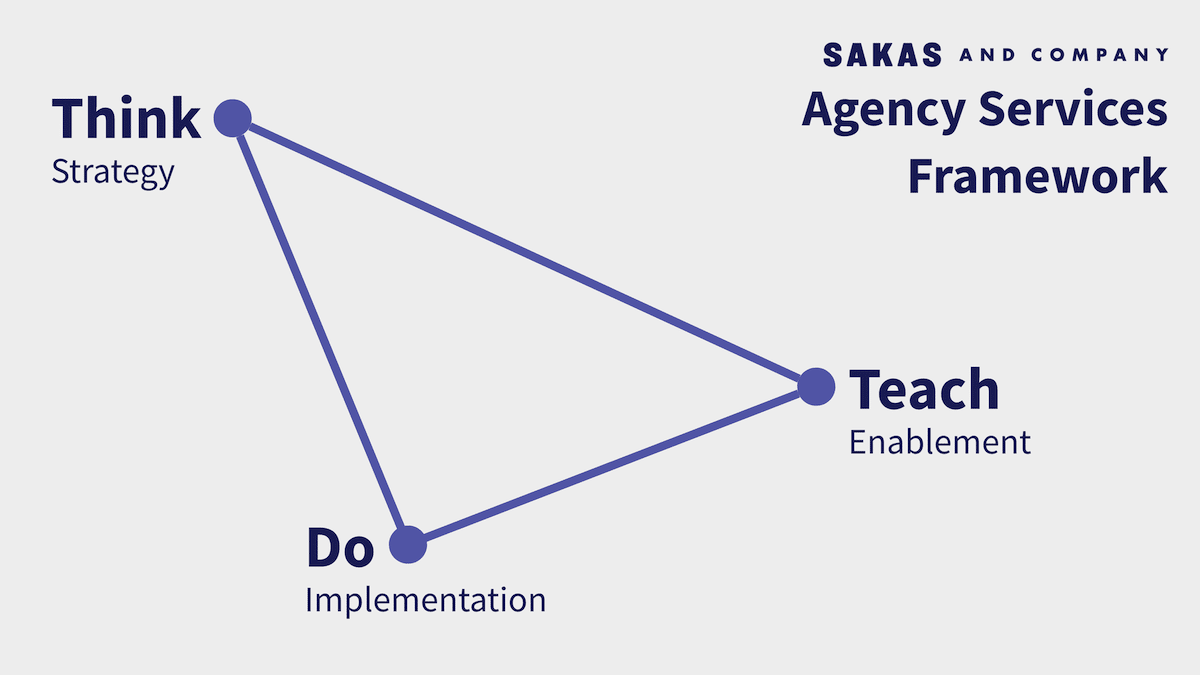
These names reflect what clients need and want. Yet every agency service fits into just three categories—what I call Think, Teach, Do.
- Think is strategy. Your client says, “Tell me what to do.”
- Teach is enablement. Your client says, “Help us learn how to do it ourselves.”
- Do is implementation. Your client says, “Do it for us.”
Your mix of those services shapes your positioning, profit margins, staffing, and the agency you’re building.
I’ve used the “Think, Teach, Do” services framework for years because the underlying client needs don’t change.
Yes, technologies and channels change, and AI creates new client expectations. But ultimately, your clients need help making good decisions (Think), building internal capabilities (Teach), and getting important work done (Do).
Your job is to be strategic about the services model you choose. And if you don’t choose it intentionally, you’ll deal with the consequences.
Think: Help clients make better decisions
In Think, clients are buying your judgment. That can include a broad marketing strategy, advice about positioning, research and analysis, prioritization, a roadmap, or simply helping a client determine the best next move.
Sometimes there’s a tangible deliverable, such as an audit or strategic plan. But the real value comes from helping the client make a better decision. That distinction is important.
Clients rarely have unlimited time, money, or attention. They’re also juggling internal stakeholder politics.
A good strategist helps your clients see what matters, evaluate trade-offs, and avoid expensive wrong turns. Sometimes the most useful recommendation is what to stop doing.
Strong “Think” work can support attractive profit margins because value is less directly tied to production volume. But it also requires trust. Prospects may struggle to evaluate the quality of strategic advice before they buy it, especially when several agencies claim similar expertise.
Case studies and business outcomes often matter more in the sales process than a visual portfolio, especially with enterprise clients. And strategy-only firms spend a lot of time on sales, because there’s less built-in recurring revenue.
Doing just “Think” affects hiring, too. Assessing strategic judgment is harder than checking whether someone can execute a defined task. And if clients are paying primarily for the founder’s judgment, a profitable strategy practice can still create substantial owner dependence.
To balance those tradeoffs, agencies often combine “Think” with another category (typically implementation via “Do” services); more on that later.
Teach: Build the client’s capabilities
In Teach, clients want to become more capable themselves.
I used to describe this category as “training and empowerment.” I now use the broader term “enablement.” It can include workshops, coaching, playbooks, documentation, change management, recruiting employees for clients, and helping a client-side team build a skill they want to own long-term.
The outcome is capability. This can be especially useful when a client wants to bring work in-house. Instead of ending the agency engagement, it becomes a different kind of relationship: helping the client’s team take over successfully. In my experience, this transition can still take months—or even years.
“Teach” also creates opportunities to get paid for your intellectual property. A strong workshop, methodology, or playbook can improve over time as you apply it with additional clients.
But there are two important constraints.
- First, excellent practitioners are not automatically excellent teachers. A subject-matter expert may do exceptional work—yet struggle to explain the process, diagnose where someone is stuck, or adapt the material to different skill levels.
- Second, supplementary paid resources are harder to turn into meaningful revenue than they may appear.
Why the monetization disconnect? Clients now have an enormous supply of free information, inexpensive training, and AI-generated guidance. A paid course, toolkit, or resource needs a compelling reason to exist—and then requires ongoing marketing, strong production value, maintenance, and updates. See my two-part guide to course creation for agencies.
This effort can still be worthwhile—but treat it as a product that needs investment, rather than passive revenue that magically appears the moment you record a workshop.
Plan to pay for legal advice, too. For example, attorney Sharon Toerek at Legal+Creative has a particular expertise in protecting (and monetizing) your IP.
Do: Deliver the outcome
In Do, clients want the agency to execute. That includes creative production, paid media, development, content, SEO, marketing operations, campaigns, and other ongoing delivery.
Strong implementation gives clients more than just deliverables and completed tasks. It gives them access to expertise, capacity, coordination, and accountability—and relief from managing the work themselves.
“Do” tends to require more operational infrastructure. As delivery volume grows, you need the right Specialists, managers, processes, capacity planning, and quality controls. A service that sells easily can become painful if the agency cannot deliver it consistently and profitably.
You’ll also face commoditization pressure. When a prospect believes several agencies can produce essentially the same output, price becomes more influential. AI increases that pressure, when clients know (or believe) production is substantially faster or easier.
That does not make implementation low-value. Premium “Do” work often combines specialized expertise, speed, orchestration, quality, risk reduction, and accountability. A sophisticated client may happily pay more when the stakes are high and they trust the agency to get the outcome right.
The danger is becoming an interchangeable pair of hands.
Most agencies combine Think, Teach, and Do
Many agencies naturally combine the categories.
- A strategy-first agency might “Think” and then “Do”: determine the right approach, then execute it.
- A consultancy might “Think” and “Teach”: recommend the right approach, then enable the client’s internal team to carry it forward.
- Other firms provide services in all three categories—moving between strategy, enablement, and implementation as each client’s needs evolve.
Offering more categories gives you more ways to help clients. It also increases the range of expertise you need to sell, staff, manage, and deliver.
That’s why the mix has implications well beyond your service menu. For example:
- A “Do”-heavy agency usually needs more delivery capacity and operational coordination.
- A “Think”-heavy agency may need fewer production resources, but it depends heavily on people whose judgment clients trust.
- “Teach” requires a blend of expertise, facilitation, and intellectual property.
The mix also affects owner dependence. If your highest-value services require the owner to sell and deliver them personally, growth hits a ceiling unless you can transfer that expertise.
Over time, your service mix impacts your profit margins, positioning, leadership needs, scalability, and enterprise value.
You don’t need every category, but you do need a combination that fits your clients, your team, and the agency you want to build.
AI changes the economics of all three
AI accelerates work across Think, Teach, and Do.
For “Think,” it can speed up research, synthesis, analysis, and early drafts. For “Teach,” it can make it easier to create documentation and personalized learning experiences. For “Do,” it can dramatically reduce the time required for certain production tasks.
The greatest pricing pressure tends to appear where clients can see that the work takes less time than it once did.
That makes it increasingly difficult to rely on labor hours as the primary explanation for value. The pricing logic breaks when you charge based on hours but the same work now takes far less time.
The stronger position is to understand what the client values beyond production time: expertise, judgment, integration, quality, speed, reduced risk, and accountability for the result.
I explore the pricing implications further in my article on the impact of AI on hourly pricing, and the operational opportunity in scaling your agency with AI.
AI will continue to change how agencies produce the work. Think, Teach, and Do remains useful because it starts with what the client needs rather than how many hours the agency spends delivering it.
How this fits with my other agency frameworks
Think, Teach, Do answers a fundamental question: What are clients buying from your agency? This is especially helpful as you add new services, or consider which services to continue vs. discontinue.
It works together with several other frameworks:
- My Agency Models framework—Front-End, Back-End, and Full-Stack—addresses how to structure your agency to deliver value.
- My Agency Roles framework looks at the people side: Who needs to own the work?
- My Agency Optionality framework shows owners how to remove themselves from day-to-day operations.
Your services define what you sell. Your agency model determines how you deliver it. Your roles define the capabilities you need. And Agency Optionality helps you reduce owner dependence over time.
As your agency grows, those choices become increasingly consequential. They shape how dependent the business is on you, how effectively the team can scale, and how many options you have for the company over time.
That’s the broader value of Think, Teach, Do. It gives you a powerful way to look past the names on your service menu and see what clients are actually hiring you to provide.
Question: Does your current Think, Teach, Do mix support the agency you want to build?
Note: Originally published in 2014; substantially updated in September 2026.